Indiana requires every new driver with a learner’s permit to complete at least 50 hours of supervised driving practice, and at least 10 of those hours must be at night. You keep track of those hours in a Log of Supervised Driving, State Form 54706, and you hand it to the BMV when your teen applies for their license.
That log is the one piece of paper standing between your teen and license day. If the hours don’t add up, a signature is missing, or the night hours aren’t there, the trip to the branch ends early. So let’s walk through it from the first drive to the last signature.
What the 50-hour driving log is, and who needs one
The log is how Indiana knows your teen has had real practice behind the wheel before they drive alone. Every new driver in Indiana records the 50 supervised hours, whatever their age. Driver’s education doesn’t replace the log either: the hours are still required after a driver’s ed course.
The official form is the Log of Supervised Driving, State Form 54706. You can download it from the BMV’s driver’s license and permit forms page. The current version is revision 8-24. It asks for your teen’s name and driver’s license number, then a line for each drive: the date and how long you drove, split into day and night.
One exception to know about. If your teen’s learner’s permit carries a daylight-only restriction, they don’t need the 10 night hours. They still need all 50 hours.
How many hours, and how many at night
The numbers are simple:
- 50 hours of supervised driving in total
- 10 of those 50 at night
The night hours count toward the 50. They aren’t extra.
How long does that take? Your teen has to hold the permit for at least 180 days before applying for a license, so 50 hours works out to about two hours a week over six months. A 20-minute drive to school and back most days gets you there with time to spare. The families who struggle are usually the ones who leave the hours for the last few weeks.
What counts as night? Here’s a quick test for you: what time does “night” start on Indiana’s log? It’s a trick question. Neither the law nor the BMV’s log sets an exact clock time. The safe rule is to count it as night once it’s dark enough that Indiana law requires headlights, between sunset and sunrise. In early summer that means late in the evening. In December it can be dark by dinnertime.
That’s good news for busy families. A winter drive home from practice can count as night driving long before bedtime.
Coming soon: what counts as night driving on Indiana’s log, and how to get your 10 hours.
Who can be a supervising driver
Not every adult can sign off on practice hours. The person in the passenger seat is the supervising driver, and Indiana is specific about who qualifies.
If your teen is under 18, the supervising driver can be:
- A licensed driver at least 25 years old who is related to your teen by blood, marriage or legal status
- A licensed spouse at least 21 years old
- A licensed driver education instructor working under a driver training school
- A certified driver rehabilitation specialist working through a driver rehabilitation program
The form also allows a licensed driver at least 25 who is approved by the Department of Child Services.
If the new driver is 18 or older, the supervising driver is a licensed driver at least 25 years old, or a spouse at least 21.
Parents, here’s the practical part. You don’t have to do all 50 hours yourself. A grandparent, an aunt or uncle, or an older sibling who’s 25 or older can share the load, as long as they’re licensed and related to your teen. Spreading the hours out also gives your teen practice with different drivers’ habits, which helps.
How to fill out the log so it’s accepted
The form is short, and that’s exactly why small mistakes stand out. Here’s how to fill it out:
- Write in blue or black ink, or fill the form in on a computer and print it. The form asks for one or the other.
- Fill in your teen’s name and driver’s license number at the top of the log.
- Log every drive on its own line. Write the date, then the drive time in hours and minutes.
- Put each drive’s time in the right column. Daytime minutes go under day, nighttime minutes under night. A drive that starts at dusk can have some of each.
- Add more pages if you need them. The form says multiple logs can be completed and attached.
- Sign the affirmation. If your teen is under 18, a parent or guardian signs. If they’re 18 or older, only the driver signs.
That last step matters more than it looks. The signature certifies that your teen completed 50 hours, 10 at night, with an eligible supervising driver. The form itself warns that a false statement may count as perjury. Log real drives, and log them honestly.
A few habits that keep the log clean:
- Log the drive the day it happens, not at the end of the month from memory.
- Total the day and night columns as you go, so you always know where you stand.
- Keep the log somewhere safe and dry. If it goes missing, so do the hours.
Coming soon: paper log or app, and which ways of logging the BMV accepts.
Keeping the log as you go: paper or app
You have two ways to keep your teen’s log.
The paper form. It’s free, it’s official, and it works. It also depends on someone remembering to write every drive down, adding up the minutes correctly and keeping the pages safe for six months or more.
An app. A driving log app records drives as they happen, so nobody has to reconstruct them later. The question to ask about any app is simple: will the BMV accept what it produces? For most apps, the answer is that you’ll still copy the hours onto the paper form.
That’s where Drive Now comes in.
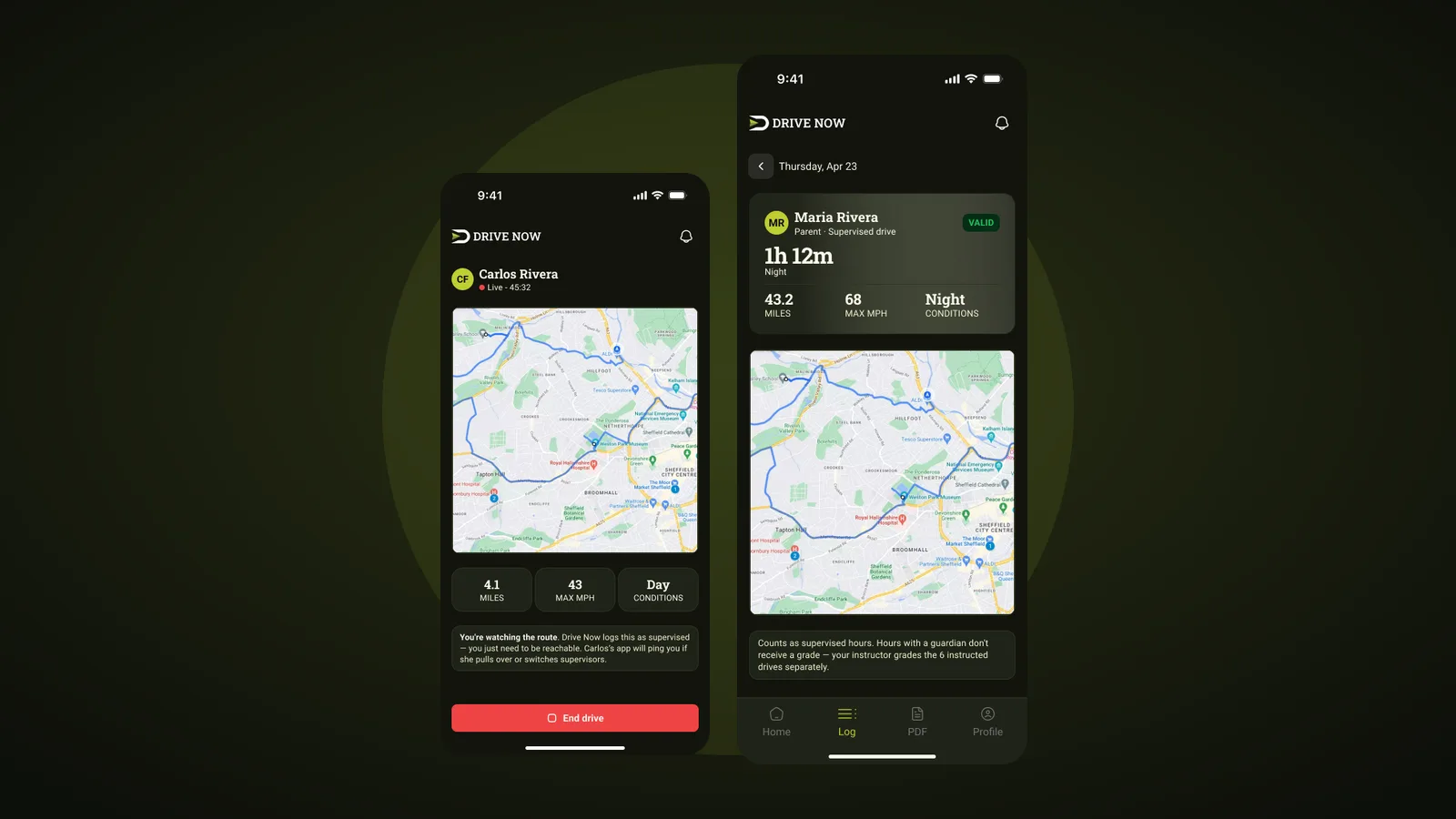
Drive Now. Every hour. Every drive. Logged. The app tracks each practice drive by GPS, sorts the time into day and night for you, and keeps it in the cloud, so the log can’t get lost in a backpack. The Indiana BMV accepts the Drive Now app log. And it’s free.
If your teen trains with a driving school that uses Drive Now, their instructor drives and your supervised drives live in the same place, so you, your teen and the school all see the same numbers.
From permit to license: where the log fits
The log is one step in a longer path. Here’s how it fits in.
Getting the permit. Students can drive with a parent during driver’s education once they’re at least 15, have completed 30 hours of the classroom or online portion, hold a learner’s permit and are enrolled in a BMV-licensed behind-the-wheel program. That’s when the logging starts.
Holding the permit. Your teen must hold an Indiana learner’s permit for 180 days, about six months, before applying for a probationary license. That’s plenty of time to reach 50 hours if you drive a little every week.
Applying for the license. To apply, your teen must:
- Be at least 16 with a completed driver’s education program, or at least 16 years and 270 days without one. Since July 1, 2026, teens who finish driver’s ed no longer wait the extra 90 days after turning 16.
- Bring the signed Log of Supervised Driving to a license branch
- Bring proof of completing driver education, if they took it
- Pass a vision screening
- Pass a driving test, unless their driver education provider offers a skills test waiver
If your teen is under 18, a parent, guardian or other willing adult also signs an agreement of financial liability.
The first months with a license. For the first 180 days on a probationary license, your teen can’t drive between 10 p.m. and 5 a.m., and can’t carry passengers unless an approved adult is in the front seat. Immediate family members are the exception. More hour limits apply after that, until they turn 18, with exceptions for work, school-sanctioned activities and religious events.
Coming soon: every step from learner’s permit to license in Indiana.
Your first week: a quick checklist
You don’t need to plan all 50 hours today. You need a good start. This week:
- Pick your log. Download State Form 54706 from the BMV, or set up Drive Now on your teen’s phone.
- Agree on your supervising drivers. Decide who in the family is 25 or older, licensed and willing to ride along.
- Take the first drive. A quiet parking lot or neighborhood loop is perfect. Log it the same day.
- Put a night drive on the calendar. Ten hours of night driving go faster in the fall and winter, when it gets dark early.
- Choose where the log lives. One folder, one app, one place everyone knows.
Every hour your teen spends behind the wheel with you now makes them a safer driver later. Start this week, keep it steady, and license day will take care of itself.
Frequently asked questions
How many hours do you need to drive with a permit in Indiana?
Indiana requires at least 50 hours of supervised driving practice, and at least 10 of those hours must be at night. The hours are recorded in a Log of Supervised Driving and presented to the BMV when your teen applies for a driver’s license.
Who can sign an Indiana driving log?
For a driver under 18, a parent or guardian signs the log’s affirmation. The supervising driver during practice must be a licensed relative at least 25, a licensed spouse at least 21, a licensed driver education instructor, or a certified driver rehabilitation specialist. Drivers 18 or older sign the log themselves.
Do I still need the 50-hour log if my teen takes driver’s ed?
Yes. Every new driver in Indiana, whatever their age, records the 50 supervised hours, even after finishing driver education. Driver’s ed and the supervised hours work together.
What if my teen’s permit has a daylight-only restriction?
With a daylight-only restriction on the learner’s permit, your teen doesn’t need the 10 hours of night driving. They still need all 50 hours of supervised practice.
Can I keep my Indiana driving log on an app?
Yes, with the right app. The Indiana BMV accepts the Drive Now app log, which records each drive by GPS and sorts the hours into day and night automatically. With other apps, check whether the BMV accepts what they produce, or copy the hours onto State Form 54706.